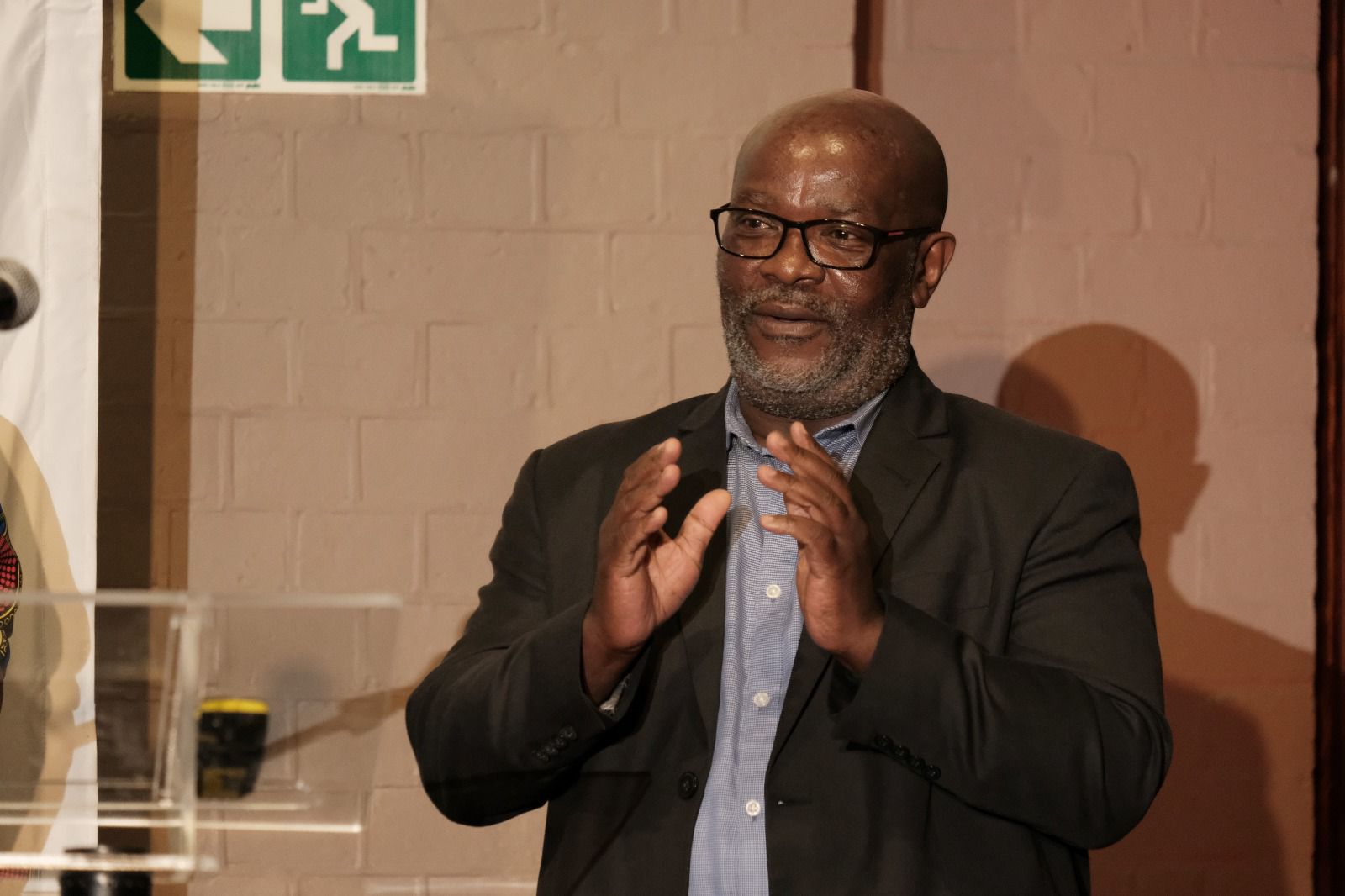
South African National Deaf Association Director Jabulane Blose urges government investigation into challenges confronting Deaf students in special schools. Picture supplied.
Dear Ms Khomotjo Joy Maimela, Chairperson of the Portfolio
Committee on Basic Education, Ms Siviwe Gwarube, Minister of Basic Education, Members
of Parliament and the Portfolio Committee and the Citizens and Public of South
Africa
We write this open letter as the South African National Deaf Association (SANDA), the leading human rights and advocacy organisation of, by and for Deaf people in South Africa. Established in 2004, SANDA exists to protect the dignity, rights, and future of Deaf people. We bring this matter to the nation’s attention following the deeply disturbing allegations reported concerning KwaThintwa School for the Deaf in KwaZulu-Natal.
These allegations include Deaf learners being forced to write up to three examinations in a single day as punishment; incidents of sexual and physical abuse by staff members; unsafe hostel conditions with inadequate supervision; and intimidation and retaliation against learners who attempt to exercise their rights.
Although these reports originate at KwaThintwa School for
the Deaf, they are not isolated. They reveal a deep and systemic failure in
governance, safeguarding systems, and accountability structures across schools
for the Deaf in South Africa. These failures demand urgent national attention.
For this reason, SANDA calls for a comprehensive,
independent national inquiry into the state of Deaf education and safeguarding
practices in South Africa.
HISTORICAL CONTEXT – SANDA WARNED THE DEPARTMENT OF BASIC
EDUCATION IN 2018
This crisis did not begin in 2025. In 2018, SANDA formally wrote to the then Minister of Basic Education warning about the deteriorating conditions within the Deaf education sector. In that communication, SANDA cautioned that Deaf education had become a closed ecosystem with limited public visibility and participation. It was dominated by entrenched hearing institutional gatekeepers who were resistant to transformation and accountability. It was characterised by multiple and intersecting forms of abuse and discrimination, and it was structurally organised in ways that silenced Deaf learners.
SANDA warned that the system’s closed nature created an
environment where Deaf learners were left unprotected, invisible, and
voiceless. These warnings were ignored. The KwaThintwa crisis is therefore not
unexpected; it is the predictable outcome of years of inaction.
BACKGROUND RATIONALE FOR A NATIONAL INQUIRY
For decades, schools for the Deaf have operated as a closed
system — insulated, linguistically inaccessible, and resistant to external
scrutiny. This structural isolation is the single most important factor
explaining why abuse persists and why systemic failures remain unresolved. It
also contributes directly to stagnant teaching quality and the ongoing language
deprivation experienced by many Deaf children.
The situation at KwaThintwa is not an anomaly. It is the
foreseeable result of a system that has been closed, unmonitored, and
unaccountable for generations. SANDA therefore presents seven contextual
realities as the foundation for a national Parliamentary inquiry.
Vulnerability of Deaf Children in Boarding Schools
Deaf children are among the most vulnerable learners. Most
Deaf children attend boarding schools far from their families. This physical
separation, combined with language barriers, makes them overwhelmingly
dependent on school staff for safety, communication, emotional wellbeing, and
protection. Within such closed environments, abuse can flourish undetected.
Power Imbalances Between Deaf Learners and Hearing Staff
Power imbalances are entrenched and intensified by the
closed nature of schools for the Deaf. Many staff members lack full proficiency
in South African Sign Language (SASL), creating an unequal environment where
hearing adults control communication, interpretation, reporting, discipline,
and even investigations. This linguistic and institutional dominance creates
dangerous dependency. Deaf learners cannot report abuse safely or effectively,
and their experiences are routinely dismissed, misunderstood, or overridden by
adult authority.
Communication Barriers That Conceal Abuse
Communication barriers prevent transparency and allow closed
systems to shield wrongdoing. When Deaf learners cannot communicate freely or
safely in SASL with investigators, social workers, district officials, or other
external authorities, complaints are lost, distorted, or dismissed. Abuse goes
unreported. Institutional narratives then overpower learner voices, creating a
vacuum where incidents disappear and learners are silenced. This is not
accidental, it is structural.
Resistance to SASL-Based and Rights-Based Transformation
With the official recognition of SASL, Deaf learners are
asserting their rights and challenging historical injustices. Yet schools for
the Deaf continue to rely on outdated, punitive practices that silence learners
rather than align with a constitutional, rights-based, linguistically inclusive
environment. This resistance reflects a clash between modern constitutional
values and entrenched institutional culture — a clash requiring decisive
Parliamentary intervention.
Deaf Schools as the Bedrock of Deaf Culture
More than 90% of Deaf children are born to hearing families
with no exposure to SASL. Schools for the Deaf therefore serve as the cradle of
language acquisition, cultural identity, peer belonging, and community
development. When these schools become unsafe or linguistically inaccessible,
the damage extends across identity, mental health, adulthood, employment,
leadership, and community cohesion. Harm becomes generational.
Transparency and Constitutional Accountability
Although the Constitution requires openness and
accountability, schools for the Deaf remain among the least transparent public
institutions. Many operate in secrecy, insulated from public oversight. This
inward-facing culture is inconsistent with constitutional values and
perpetuates violations.
Public and Deaf-Led Accountability Is Essential
Internal investigations have consistently failed. Staff
investigate colleagues. Learners are intimidated. Evidence disappears. Problems
persist. SANDA therefore insists that any accountability process must be
public, transparent, independent, under oath, and led by Deaf professionals.
The SASL Charter (PanSALB, 2023)
The Charter affirms that SASL is the primary language of
Deaf people and places obligations on the State to ensure SASL is the central
language of learning and teaching; to guarantee Deaf inclusion in decisions
affecting them; to maintain SASL-competent teachers and hostel staff; and to
uphold transparent governance. These obligations are routinely violated.
Affiliation and Governance Considerations
Some schools for the Deaf maintain affiliations with
external Deaf-sector organisations. While collaboration is valuable, public
schools are organs of the State and must remain neutral and accountable. Where
affiliations blur governance boundaries, accountability is weakened and closed
cultures are reinforced. This is a systemic governance concern requiring clear
public-sector guidance.
RECOMMENDATIONS
SANDA therefore calls on Parliament to:
·
Launch a National Inquiry into safeguarding
failures, governance, and systemic practices in all schools for the Deaf.
·
Ensure structured public participation involving
Deaf adults, former learners, School Governing Bodies, and the Deaf community.
·
Summon provincial education departments to
present historical records, investigations, and safeguarding responses.
·
Appoint an Independent Oversight and
Investigation Panel comprising Deaf leaders, SASL-competent investigators,
child protection experts, trauma specialists, and legal analysts.
·
Implement emergency safeguarding measures at
high-risk schools.
·
Conduct a national review of hostel safety,
staff qualifications, SASL standards, interpreter access, governance, and
institutional culture.
·
Conduct a national academic review of curriculum
delivery, assessment practices, and learner outcomes in schools for the Deaf.
KwaThintwa School for the Deaf is not an isolated incident.
It is the clearest evidence of a national crisis decades in the making — a
closed, unaccountable system that continues to fail Deaf children. SANDA warned
the Department of Basic Education in 2018. The failures now surfacing demand
decisive Parliamentary action.
A comprehensive national inquiry is urgent, necessary, and
indispensable as the only credible path to safeguarding the rights, safety,
dignity, and future of every Deaf child in South Africa and restoring
constitutional compliance in Deaf education.
SANDA stands ready to support Parliament with Deaf-led
expertise and remains available to make an oral submission should further
engagement be required.
Yours sincerely,
Jabulane Blose