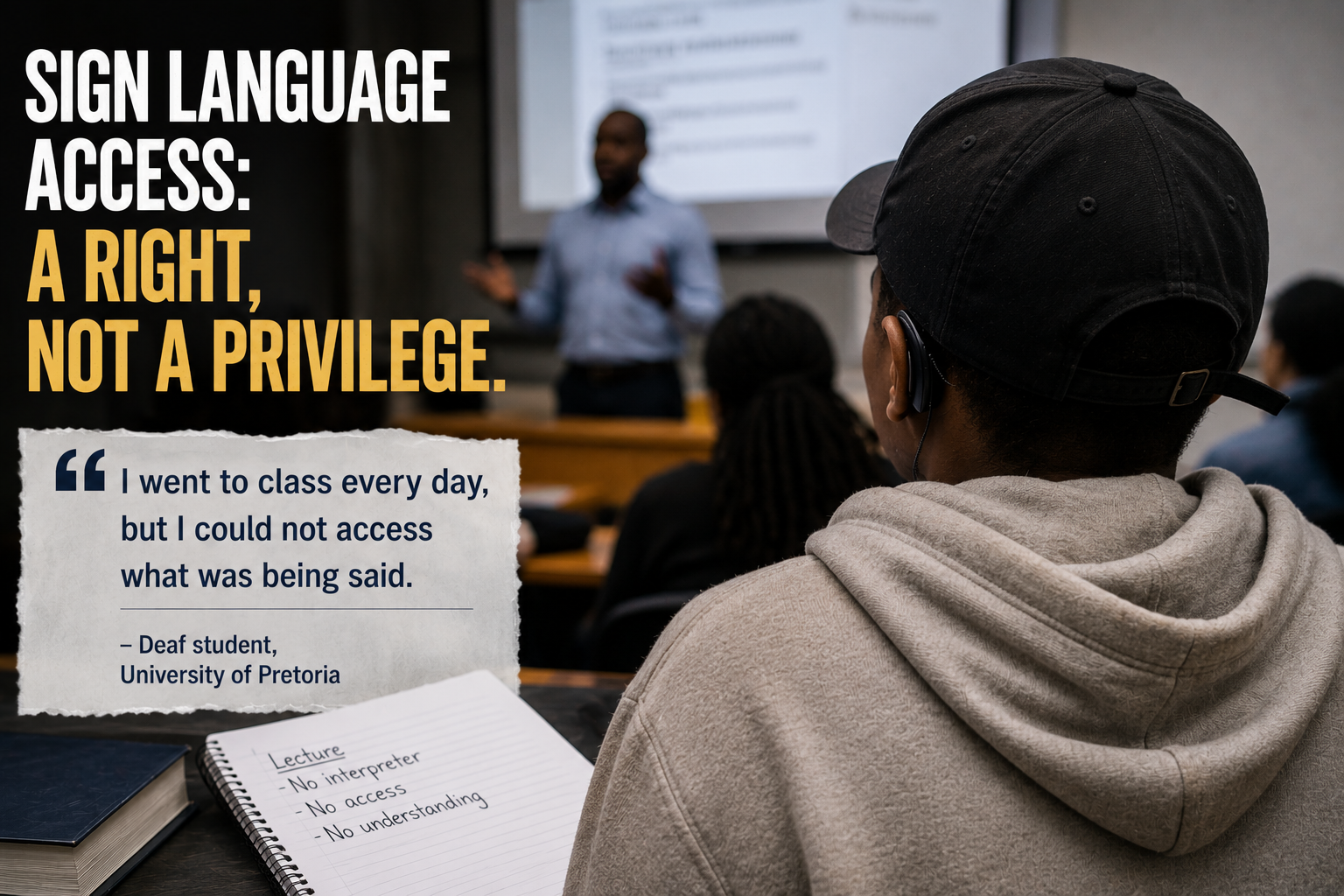
Illustration depicting a Deaf university student attending a lecture without South African Sign Language interpretation. The image is an artistic representation created to illustrate the issues raised in this story and does not depict the applicant or any actual person, classroom, or event.
A Deaf student had no
choice but to drag the University of Pretoria (UP) to the Equality Court to
force the university to provide her with South African Sign Language
interpretation during lecture sessions.
She had spent over a year
without South African Sign Language interpretation and cited this as a
contributing factor to her academic failure.
The student, who is the
main applicant in the matter, stated in her court submissions that since 2025,
all her lecture sessions for her Bachelor of Arts degree had been conducted
without an interpreter.
Her attorney, Ektaa Deochand, from the Legal Resources Centre (LRC), said UP has now agreed to provide their client with an interpreter. However, a court order has not yet been finalised. She said the court order will probably be released in the next two weeks.
Deochand said:
"They have
provided her with SASL interpretation as of this semester. We are still working
out a settlement on the policy."
Represented by the LRC, the applicant cited the Minister of Higher Education and Training as the second respondent and the Minister of Justice and Constitutional Development as the third respondent in her court submissions. The second applicant in the matter is the Deaf Federation of South Africa (DeafSA).
According to her affidavit before the Equality Court, despite formally requesting reasonable accommodation as a student with a disability, the university had not provided her with a South African Sign Language Interpreter (SASLI) to interpret lectures and assessments.
The student, who has requested the Diary Series of Deaf People not to mention her name, said the alleged failure to provide her with a SASLI contributed to her academic difficulties and subsequent academic exclusion. She argued in her affidavit that this had placed her at a significant disadvantage compared to her hearing peers and negatively affected her academic performance.
She further alleged in her submissions that after failing some modules, she repeatedly appealed to the university to provide interpretation services. However, her requests were unsuccessful. She was therefore academically excluded in the 2025 academic year, a decision she believes was largely influenced by the lack of appropriate support during her studies.
This year, determined to continue her education and prompted by her belief that "disability is not inability," she successfully appealed to be re-enrolled for the academic year. However, the challenges she experienced last year continued into this year. Despite making further requests for a sign language interpreter, the university's position remained unchanged.
As a result, she brought the matter before the court. She argued that UP's refusal to provide sign language interpretation services violated her constitutional rights to equality, dignity and further education, as protected under Sections 9(1), 10 and 29(1)(b) of the Constitution of the Republic of South Africa, 1996.
Therefore, she wanted the institution to provide her with sign language interpretation for all academic engagements.
Responding to Diary Series of Deaf People's media enquiry, UP spokesperson Sashlin Girraj said the University is committed to supporting students with disabilities and to making higher education as accessible as reasonably possible.
Girraj added, “Over the years, the University has invested significantly in support services and academic accommodations for students with a wide range of needs. In this matter, the university faced particular challenges relating to the provision of specialised Sign Language interpretation for highly technical academic lectures. There is a very limited pool of suitably qualified interpreters, both in South Africa and internationally, especially for specialised academic content. In addition, interpreters can generally only work for about 20 minutes at a time before another interpreter must take over."
Girraj said:
“The cost of providing these services can exceed R40 000 per month per student, while sourcing enough appropriately qualified interpreters on a sustainable basis also presents practical difficulties.”
Girraj said the University always aims to provide reasonable accommodation and continues to engage with students and relevant stakeholders to explore appropriate support measures. However, he said there are instances where the ideal accommodation may not be fully achievable despite considerable efforts.
“These challenges are not
unique to this University. The higher education sector more broadly continues
to face difficulties in providing specialised interpretation services in
technically demanding academic environments, and institutions are working together
to find sustainable long-term solutions. As the matter is currently subject to
legal proceedings, the university is not in a position to comment further on
the specifics of the case,” said Girraj.
However, Deochand said:
“There are multiple other universities currently providing SASL interpretation as detailed in the HEDSA (Higher Education Disability Services Association) guidelines.”
The applicant argued that the absence of sign language interpretation services not only undermined her academic progress but also infringed on her right to equal access to education.
The Department of Higher Education spokesperson Matshepo Seedat said the matter has been referred to the relevant departmental branch for consideration and that she would follow up on the response.
According to court
papers, the National Strategic Framework on Reasonable Accommodation for
Persons with Disabilities sets out obligations relating to reasonable
accommodation by both public and private service providers, including
institutions of higher learning. The applicants contend that because the
framework has not been adopted as binding regulations, its application remains
limited and does not provide sufficient protection for persons with
disabilities.