

Illustration: Mental illness can affect a person's mood, thoughts and behaviour, influencing how they perceive the world around them. Picture by Synapse
The South African Electoral Commission (IEC) has reaffirmed
that people with mental disabilities have the right to vote and cannot be
excluded from elections unless a court has declared them legally incapable of
doing so.
Speaking at the disability sector workshop held at the
Garden Court in Cape Town on Wednesday, IEC Commissioner Judge Dhayanithie
Pillay drew a clear distinction between a person's mental disability and their
legal capacity, stressing that only a court—not the IEC—can determine whether
someone lacks the legal capacity to vote.
Pillay said:
She distinguished between accessibility and reasonable accommodation, saying accessibility is about the pre-emptive removal of barriers that prevent people with disabilities from participating on an equal basis. Reasonable accommodation, by contrast, involves adjustments made to meet the specific needs of an individual with a disability.

IEC Commissioner Judge Dhayanithie Pillay addresses delegates at the disability sector workshop held at the Garden Court in Cape Town on Wednesday. Picture by IEC
Pillay said:
“Reasonable
accommodation is based on what a specific person needs, and it can shift from
one circumstance to another.”
She gave the example of a person with Down syndrome who may
require assistance to understand how to cast a ballot.
The IEC staff are required to be sensitive, observant and
able to respond appropriately to the needs of persons with disabilities.
Pillay added that people who are unable to travel to their
voting stations may apply for a special vote.
The IEC states that a voter may qualify for a special vote
if they cannot travel to their voting station because they are physically
infirm, have a disability, are pregnant, or are unable to vote at their voting
station on election day.
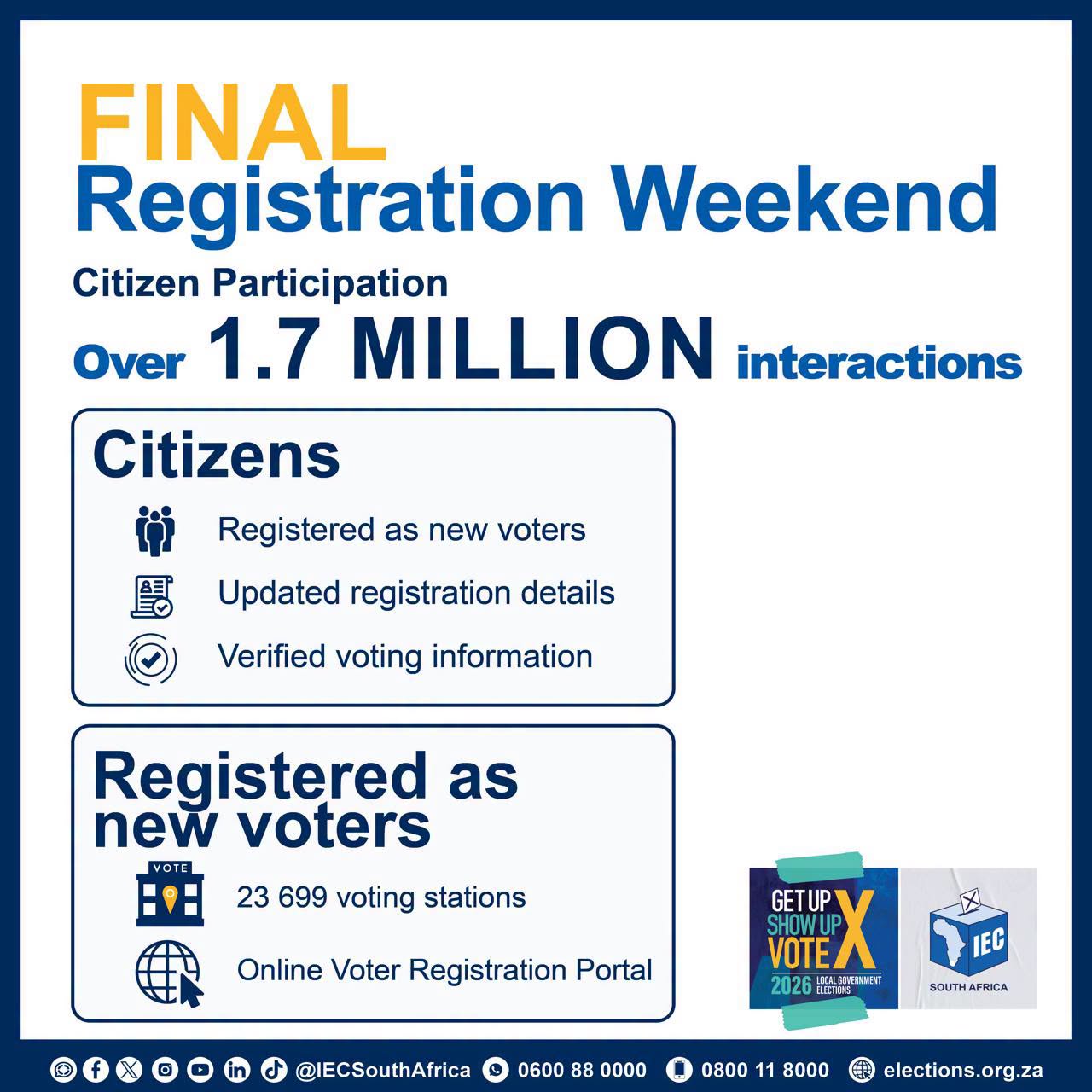
During the voter registration weekend 1.7 million citizens interacted with the Electoral Commission. Picture by IEC
During the voter registration
weekend of 1 and 2 August, 1.7 million citizens interacted with the Electoral
Commission by visiting one of the 23,699 voter registration stations or using
the online voter registration portal.
Of the 1.7 million transactions, 291,806
(16%) were first-time voter registrations. A further 1,502,245 (84%) were
existing registered voters who inspected or updated their registration details.
The IEC said the figures
reinforce its message that voters must register and vote in the voting district
and ward where they reside. In local government elections, there is no
provision for voters to cast their ballots at a voting station other than the one
where they are registered.